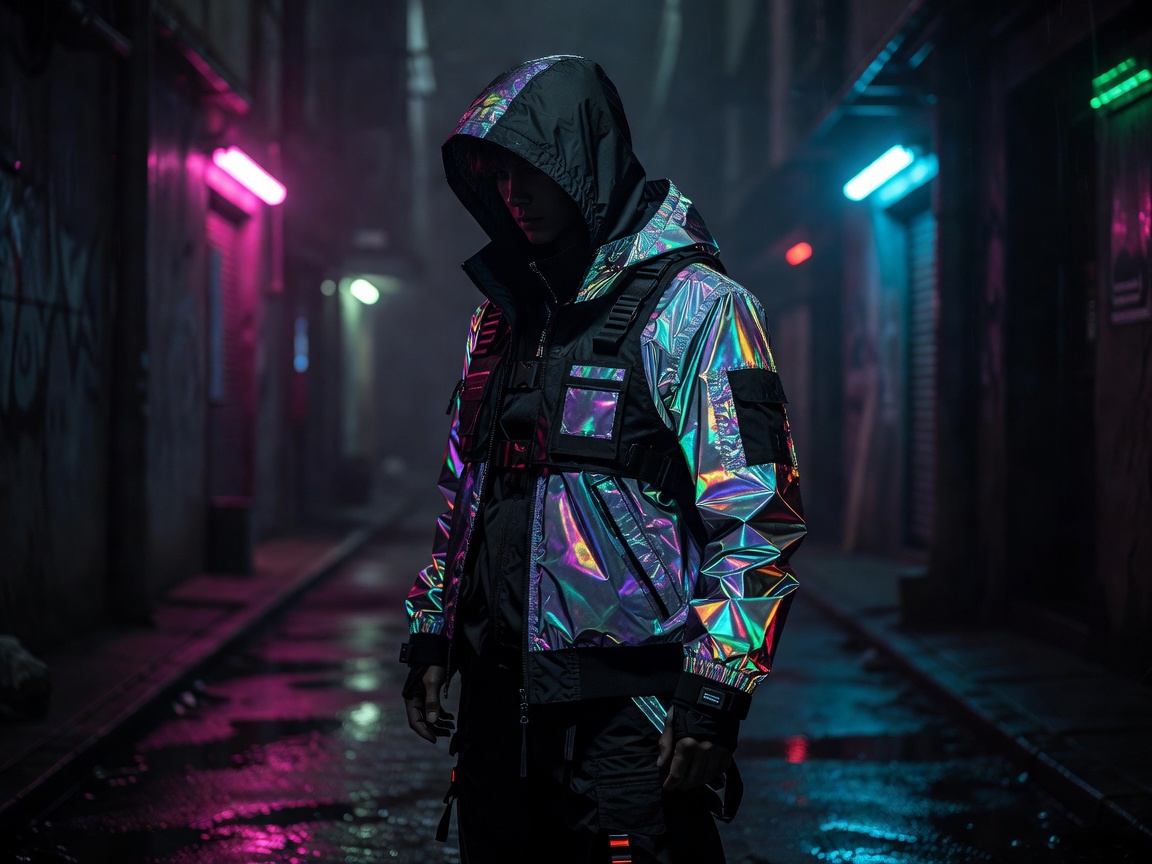
From fiction to material culture
Cyberpunk style grew from imagined environments where technology is advanced but public life is strained. Clothing therefore tends to mix practical and expressive choices: protective shapes, pockets, straps, hard surfaces, reflective materials and custom graphics. The point is not to reproduce a fictional uniform. It is to show how a person might adapt to a world where infrastructure is everywhere and security is unevenly distributed.
Four visual ingredients
Utility
Technical garments, workwear and military references suggest movement through dense urban space. Utility becomes expressive when pockets, closures and modular parts are visible rather than hidden. The risk is costume shorthand: a row of straps can imply function without providing any.
Contrast
Cyberpunk styling often places engineered materials beside worn surfaces. Gloss, mesh, rubberised textures and reflective details can sit with denim, distressed cotton or heavy knitwear. The contrast creates a sense of use and adaptation. It also keeps the look from becoming a sterile advertisement for a perfect future.
Light and sound
Music and lighting complete the visual system. Industrial electronic music, techno, drum and bass and darker forms of synth-driven sound have all contributed to cyberpunk's atmosphere, though no genre owns it. Cyan, magenta and acid yellow work because they cut through dark architectural backgrounds. Used everywhere, they become wallpaper.
Architecture
Cyberpunk cities favour layers: signage over concrete, elevated transport above pedestrian routes, cables beside glass, public space interrupted by private security. This density appears in fashion through stacked silhouettes and visible interfaces. The best references are structural rather than decorative.
How to build a coherent look
Start with one practical base, add one technical texture and choose one high-contrast accent. Consider movement, weather and maintenance before adding detail. A convincing cyberpunk outfit should look usable within its imagined environment, not merely photographed against one. The same rule applies to interiors and graphic design: let the system of materials carry the mood before reaching for a glowing sign.